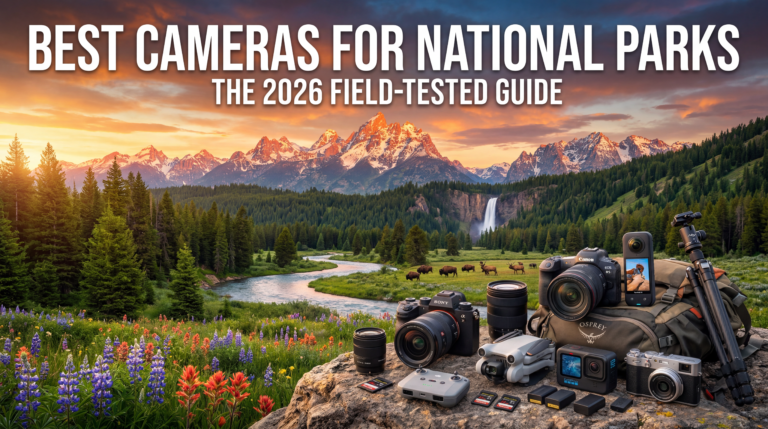
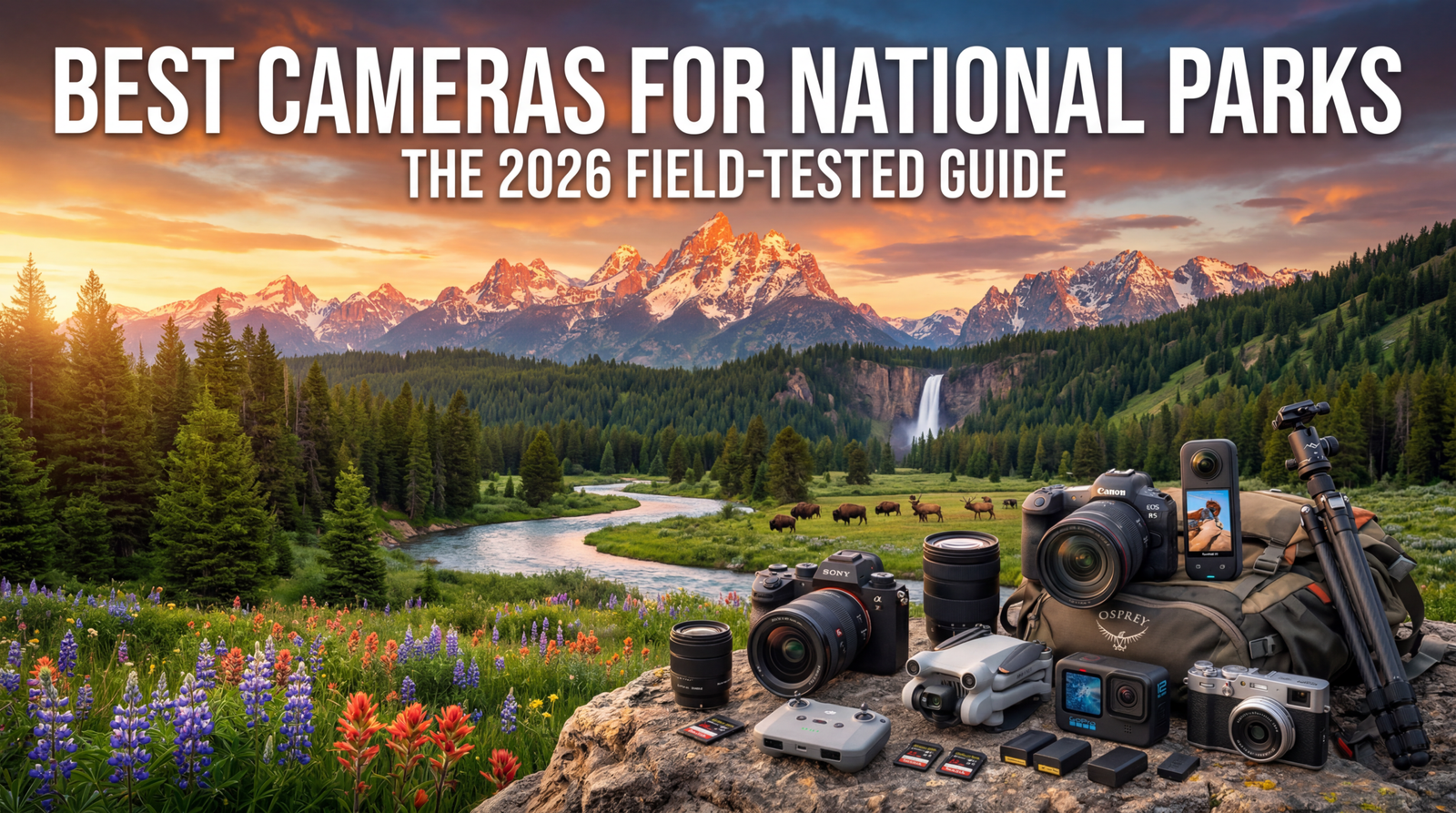
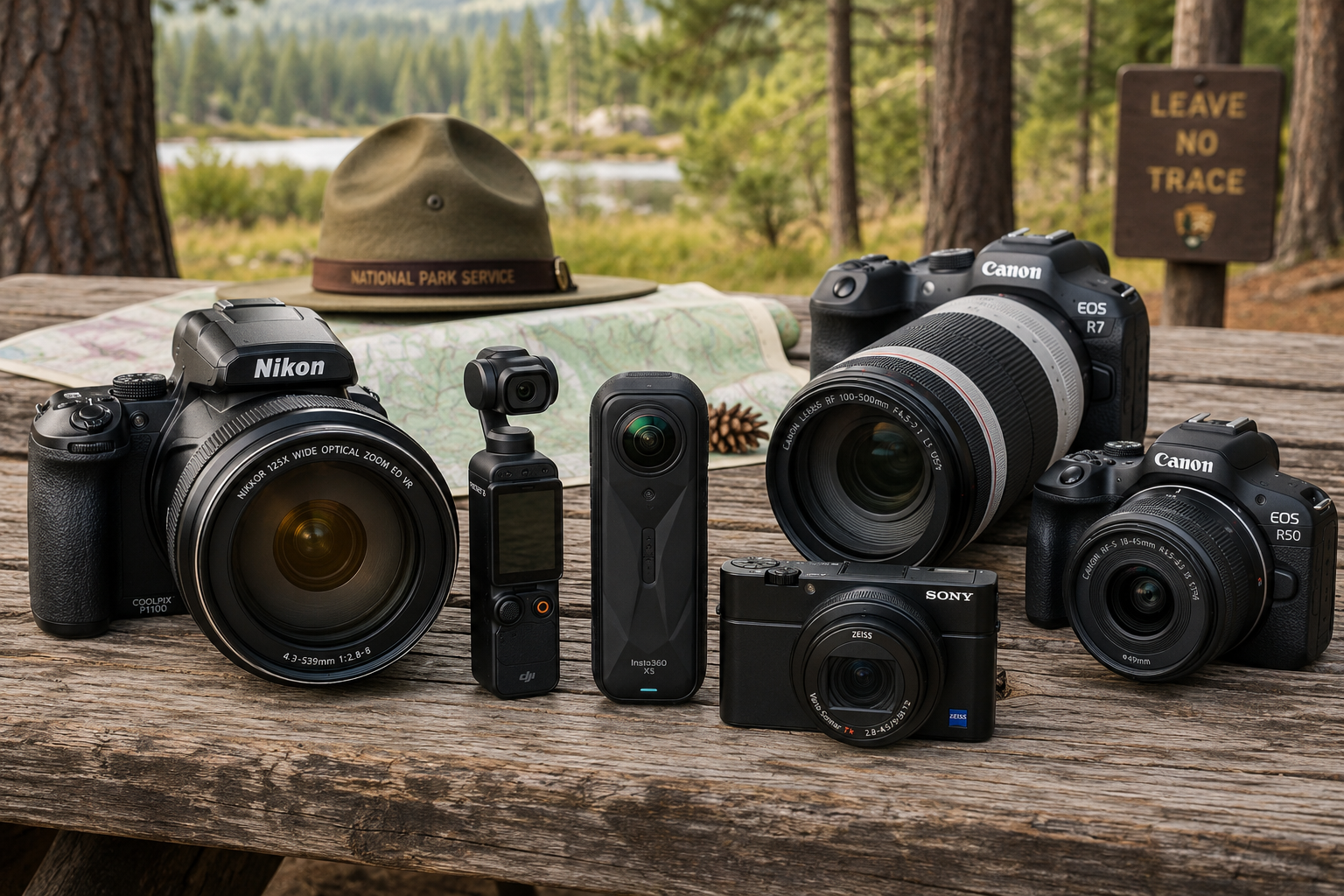
Quick Answer: The best cameras for national parks in 2026 depend on what you shoot most: the Canon R7 is the top all-around pick for wildlife and landscapes, the Sony RX100 VII wins for pocketable travel, the Nikon P1100 dominates extreme zoom reach, the DJI Pocket 3 and Insta360 X5 cover video and immersive angles, and the Canon EOS R50 is the best budget mirrorless entry point. Match the camera to your terrain, subjects, and hiking distance rather than chasing megapixels.
Gear I actually use: Every camera in this guide’s top picks — the Canon R7, Canon EOS R50, Sony RX100 VII, Nikon COOLPIX P1100, DJI Osmo Pocket 3, and Insta360 X5 — is gear I personally own and shoot with. The Fujifilm X-T5, Fujifilm X100VI, Ricoh GR IIIx, and Sony a6000 mentioned as alternatives below are not gear I own, so I’ve kept those recommendations based on specs and reputation rather than hands-on time, and flagged them clearly as non-owned picks.
⚡ Key Takeaways
- Canon R7 (APS-C mirrorless) is the strongest all-rounder for wildlife plus landscapes under $1,600.
- Sony RX100 VII stays in your pocket during 15-mile hikes and still shoots 24-200mm equivalent.
- Nikon P1100 offers a 3000mm equivalent reach, unmatched for distant wildlife on a budget.
- Canon EOS R50 is the best sub-$800 mirrorless for beginners entering park photography.
- DJI Pocket 3 is the easiest way to get gimbal-stabilized 4K video on the trail.
- Insta360 X5 captures 360-degree footage you reframe later, perfect for scenic overlooks.
- Weight matters more than specs on multi-day hikes; two pounds feels heavy at mile 12.
- Weather sealing, dust protection, and spare batteries are non-negotiable in desert or alpine parks.
What Makes a Good Camera for National Park Photography
A good national park camera balances image quality, weight, weather resistance, and focal range flexibility. Parks throw everything at you — bright canyon walls at noon, dim old-growth forests, distant elk at dusk, and dust storms in Death Valley — so versatility beats specialization.
Look for these five traits:
- Dynamic range of 12+ stops so bright skies and shadowed valleys both hold detail.
- Weather sealing rated for dust and light rain (critical in Utah, Washington, and Alaska parks).
- Focal range coverage from wide (16-24mm equivalent) to telephoto (200mm+) for wildlife.
- Battery life of 300+ shots per charge, or easy USB-C in-field charging.
- Weight under 2 lbs for the body if you plan on backcountry hikes.
Decision rule: if you’ll hike more than five miles per day with the camera on your neck strap, prioritize weight and weather sealing over sensor size.
⚠️ Common mistake: buying a full-frame body plus a 70-200mm f/2.8 lens for a Grand Canyon rim trip. That combo weighs over five pounds and most shots don’t need f/2.8. An APS-C body with a compact zoom captures the same postcard.
Best Camera Brands for Landscape Photography
For national park landscapes, Sony, Canon, Nikon, and Fujifilm lead the pack in 2026. Each has strengths worth knowing before you commit to a lens ecosystem.
| Brand | Strength | Best For | Weakness |
|---|---|---|---|
| Sony | Dynamic range, autofocus | Landscape + wildlife hybrid | Menus feel dense |
| Canon | Color science, ergonomics | Wildlife, video-heavy shooters | Fewer third-party lenses |
| Nikon | Sharpness, superzoom line | Landscape, extreme telephoto | Slower mirrorless catalog |
| Fujifilm | Film simulations, size | Travel, JPEG shooters | Weaker for fast wildlife |
Choose Sony if you want the widest dynamic range for sunrise at Bryce or Zion. Choose Canon if you shoot wildlife and video roughly equally. Choose Nikon if you want the longest zoom reach for the least money (the P1100 is unmatched). Choose Fujifilm if you shoot mostly JPEG and want beautiful colors straight out of camera.
A quick note: brand loyalty matters less than the lens you’ll actually carry. A great camera with the wrong lens produces average photos.
Mirrorless vs DSLR for National Park Shooting
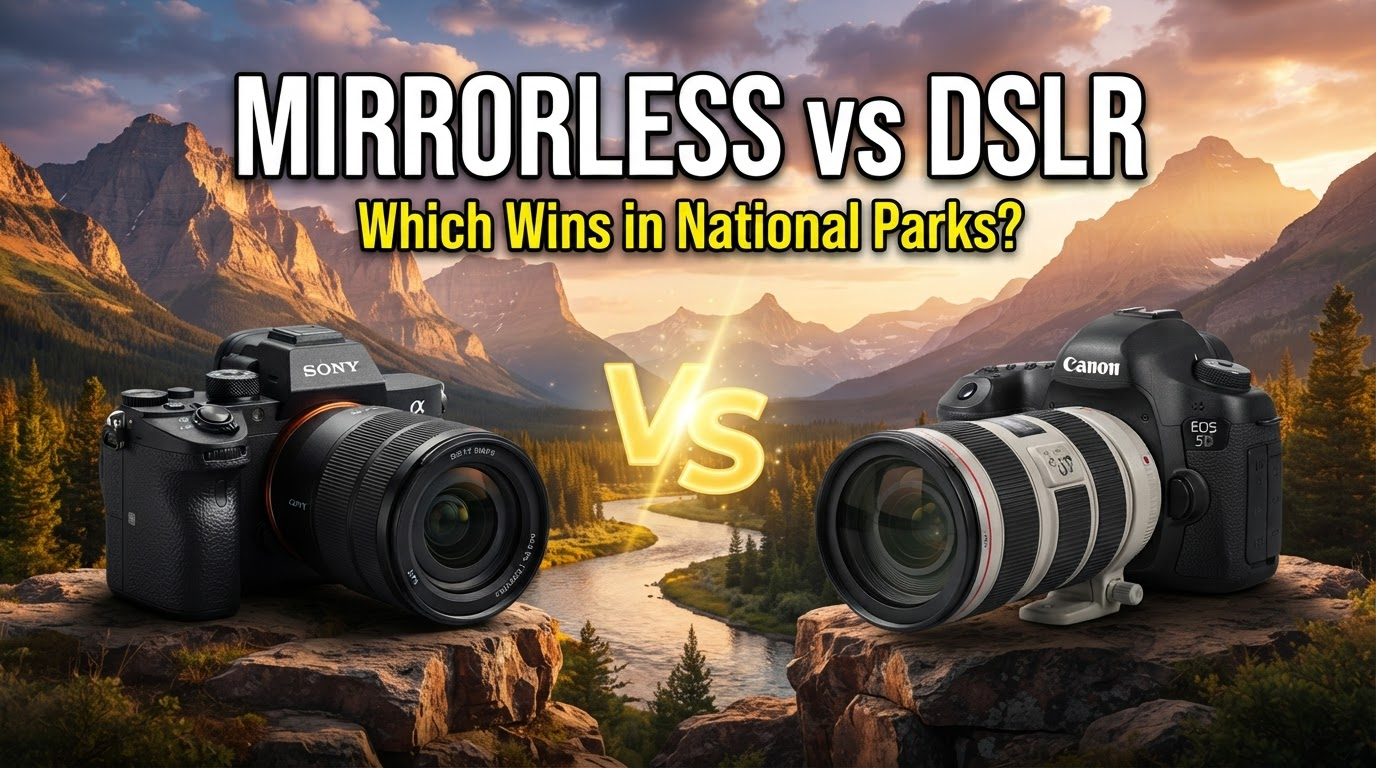
Mirrorless wins for national parks in 2026 because of lower weight, better in-body stabilization, and superior video. DSLRs are being phased out by all three major manufacturers, so lens investment goes further with mirrorless.
Mirrorless advantages:
- Typically 20-40% lighter than DSLR equivalents.
- Real-time exposure preview through the viewfinder (huge for tricky light).
- Faster, more accurate eye-detect autofocus on wildlife.
- Better 4K video capabilities.
DSLR advantages that remain:
- Optical viewfinder consumes zero battery.
- Wider used market for cheap bodies.
- Some pros still prefer the tactile feel.
Choose mirrorless if you’re buying new in 2026. Choose DSLR if you already own compatible lenses and don’t want to switch systems. For more on picking travel-friendly gear, see this 2025 travel camera roundup.
How Much Should I Spend on a National Park Camera
Budget realistically between $500 and $2,500 for a serious national park kit including one lens. Spending more rarely improves park photos meaningfully; spending less often means missing shots due to slow autofocus or short zoom reach.
Here’s how the tiers break down:
- $300–$700 (entry): Canon EOS R50 kit, refurbished RX100 VI, or Nikon P1100. Great starter, some limits in low light.
- $800–$1,500 (mid): Canon R7, Sony a6700, Fujifilm X-T5 body with a compact zoom.
- $1,600–$2,500 (enthusiast): Full-frame like Sony a7 IV or Canon R6 Mark II with a versatile 24-105mm.
- $3,000+ (pro): Diminishing returns unless you’re printing gallery-size or selling stock.
Decision rule: spend 60% on the body plus 40% on lenses if you’re just starting; flip that ratio once you own two or three lenses you love.
Best Cameras for Hiking and Backpacking Weight
If keeping your pack light is a priority, these compact cameras are excellent choices. The Sony RX100 VII (10.7 oz), DJI Pocket 3 (6.1 oz), and Insta360 X5 (7.9 oz) all deliver impressive image quality while remaining small enough to fit in most backpack hip-belt pockets. Despite their lightweight designs, each is capable of capturing professional-quality photos and video, making them ideal companions for long hikes and national park adventures.
Weight Comparison (Body Only):
Here’s how our six recommended cameras compare by weight.
| Camera | Weight | Best Use on Trail |
|---|---|---|
| DJI Pocket 3 | 6.1 oz | Stabilized video vlogs |
| Sony RX100 VII | 10.7 oz | Everything travel |
| Insta360 X5 | 7.9 oz | 360 scenic capture |
| Canon EOS R50 | 13.9 oz | Beginner hybrid |
| Nikon P1100 | 3.1 lbs | Distant wildlife (base camp) |
| Canon R7 | 1.35 lbs | Serious hybrid shooting |
Choose the Pocket 3 or RX100 VII if your daily hike exceeds 10 miles. Leave the P1100 in camp and shoot from viewpoints near the trailhead — it’s brilliant, but 3 lbs of camera plus a neck strap will ruin a long day.
Grab a compact tripod like the GorillaPod 3K, it wraps around branches and railings and weighs almost nothing.
Can I Use My Phone Camera in National Parks
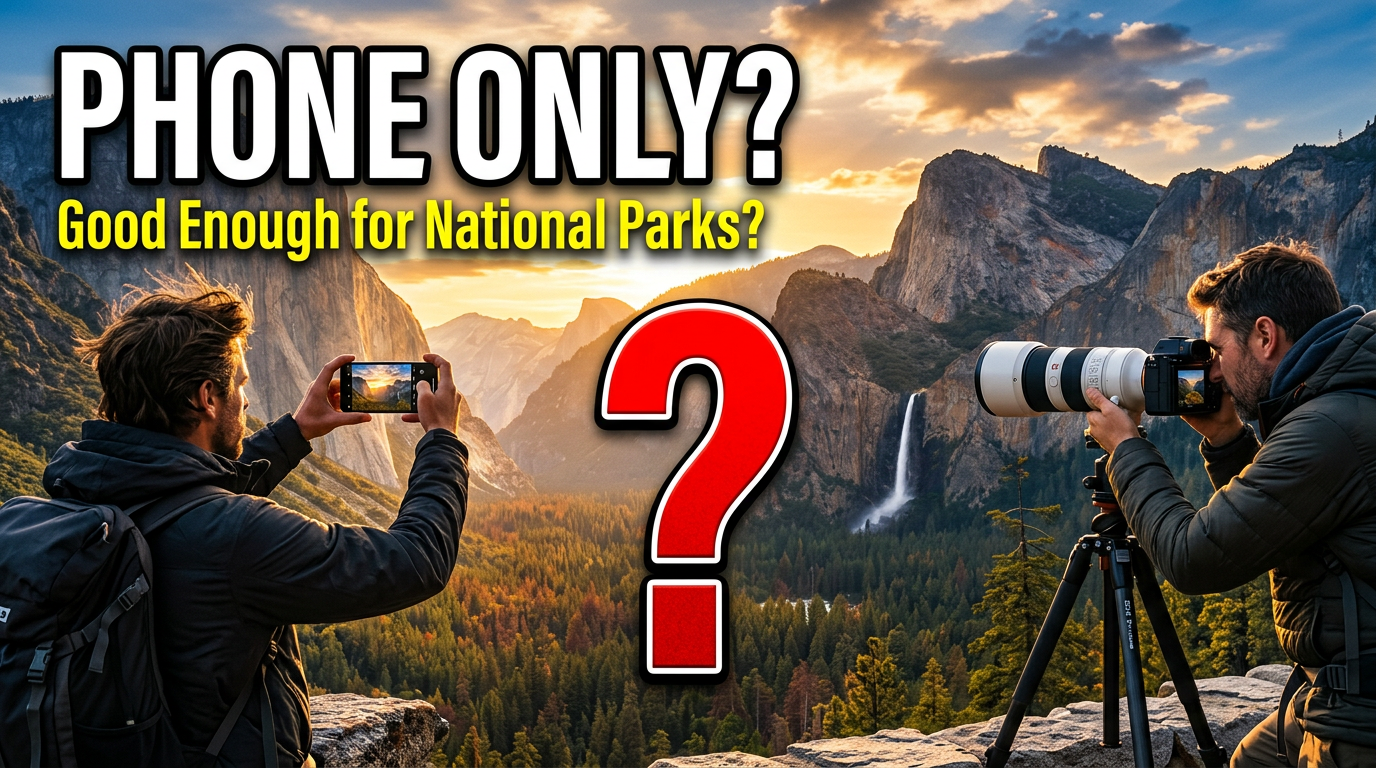
Yes, modern phones (iPhone 16 Pro, Pixel 9 Pro, Samsung S25 Ultra) shoot excellent park photos in good light and cover 90% of casual needs. Where phones fall short: telephoto wildlife shots, low-light star fields, and long exposures of waterfalls.
Phones handle well:
- Wide landscape panoramas at golden hour.
- Trail selfies and family group shots.
- Short scenic 4K video clips.
- Quick social sharing over park Wi-Fi at visitor centers.
Phones struggle with:
- Anything beyond 5x optical zoom (digital zoom looks like watercolor).
- Fast-moving wildlife (shutter lag ruins bear or bison shots).
- Night sky and Milky Way (some phones do astro mode, but a real camera destroys them).
- Extreme cold (batteries die at 15°F).
Bottom line: bring your phone regardless. Add a dedicated camera when you want printable prints, serious wildlife shots, or professional video. A pocketable second camera like the RX100 VII bridges the gap without weighing you down.
What Camera Settings Work Best for National Park Landscapes
For most park landscapes, use aperture priority mode at f/8 to f/11, ISO 100-400, and a low tripod for razor-sharp results. Meter for the highlights so skies don’t blow out, then lift shadows in editing.
Starter settings by scene:
- Grand vistas (Yosemite Valley, Grand Canyon): f/11, ISO 100, focus one-third into the frame.
- Waterfalls (Yosemite Falls, Multnomah): f/16, ISO 100, 1/4 to 2 seconds, ND filter, tripod required.
- Forest interiors (Redwood, Olympic): f/5.6, ISO 400-800, watch for wind blur in ferns.
- Milky Way (Big Bend, Bryce): f/2.8, ISO 3200, 20-second shutter, wide lens.
- Wildlife (Yellowstone, Denali): shutter priority 1/1000s minimum, auto ISO up to 6400.
⚠️ Common mistake: shooting in auto mode at midday. Harsh noon light flattens everything. Shoot 45 minutes before sunset or after sunrise — the “golden hour” — for depth, warmth, and long shadows that reveal terrain.
For editing park footage on the go, the CapCut video editor handles clips from any of these cameras.
Best Cameras for Wildlife Photography in Parks
For park wildlife, the Canon R7 and Nikon P1100 are the two strongest picks in 2026 — the R7 for image quality and speed, the P1100 for raw reach at a lower price.
Canon R7 for Wildlife Photography: The Camera I Actually Use
The Canon R7 pairs a 32.5-megapixel APS-C sensor with 30 fps electronic shutter and animal-eye autofocus that locks onto birds, elk, and bears from 100+ yards. Pair it with a Canon RF 100-400mm (effective ~640mm equivalent on APS-C) and you have a wildlife rig under $2,500 total.
The Nikon P1100 offers a 24-3000mm equivalent zoom in a single body, the longest in any consumer camera. It’s how you photograph mountain goats on a cliff face across a canyon without hiking to them. Image quality drops in low light because of the small 1/2.3″ sensor, but for daylight wildlife spotting, nothing else touches this price-to-reach ratio.
Canon EOS R50 for Beginners: The Camera I Actually Use
The Canon EOS R50 offers lightning-fast, reliable eye-detect autofocus in a remarkably compact body weighing under 14 ounces. Pair it with the versatile RF-S 55-210mm lens, and you have an exceptionally lightweight and capable wildlife starter kit for under $1,000.
For real-world wildlife tips, browse this guide to wildlife spotting in U.S. national parks.
Do I Need a Full Frame Camera for National Parks
No, you don’t need full frame for national park photography. APS-C sensors like those in the Canon R7 or Fujifilm X-T5 produce prints up to 24×36 inches that look identical to full-frame prints at normal viewing distance.
Full-frame advantages that matter:
- One stop better low-light performance (useful for astrophotography).
- Slightly shallower depth of field for portraits.
- Larger native lens selection at telephoto ranges.
Full-frame disadvantages:
- Bodies and lenses cost 30-50% more.
- Lenses weigh substantially more (a 70-200 f/2.8 is over 3 lbs).
- Effective reach is shorter — a 400mm lens on APS-C acts like 600mm.
Choose APS-C if you want lighter gear, more reach for wildlife, and lower cost. Choose full frame if you shoot in low light constantly or already own full-frame lenses.
Best Compact Cameras for National Parks
Sony RX100 VII Compact Camera : The Camera I Actually Use
The Sony RX100 VII is the top compact camera for parks in 2026, offering a 1-inch sensor and 24-200mm equivalent zoom in a jacket-pocket body. It shoots 20 fps burst, 4K video, and has a pop-up viewfinder for bright canyon light.
For a deeper look, read this dedicated Sony RX100 VII review.
Runners-up worth considering (not gear I own)
Fujifilm X100VI — larger APS-C sensor, but fixed 35mm lens (no zoom).
Ricoh GR IIIx — pocketable APS-C with a 40mm-equivalent lens, street-photography favorite
Panasonic LX100 II — Four Thirds sensor with a fast zoom, video-friendly.
Choose the RX100 VII if zoom range and pocket size matter more than the largest possible sensor. It’s the camera you’ll actually bring on every hike.
Camera Gear That's Easy to Carry on Long Hikes
Keep total camera weight under 3 lbs including body, one lens, and accessories for hikes over 8 miles. Beyond that, the gear starts influencing where you go and how long you stay.
A minimalist park hiking kit:
- One camera body (RX100 VII or Canon R7 with one lens).
- One spare battery in a zip-top bag.
- One microfiber cloth for lens dust.
- Compact carbon tripod or GorillaPod (under 12 oz).
- 64GB memory card plus one backup card.
- Weatherproof case or dry bag (parks get rain fast).
Gear that adds joy without much weight:
- DJI Pocket 3 for smooth video, around 6 oz including case.
- Insta360 X5 for scenic 360 footage you can reframe later, around 8 oz.
For carrying options, see My review of must-have camera equipment for creators..
What if I Only Have a Budget Camera for Parks
A budget camera under $500 can still produce stunning park photos — you just need to lean into its strengths and shoot at the right times. Shooting in good light beats every megapixel upgrade.
Rules for making a budget camera shine:
- Shoot at sunrise and sunset only. Midday light exposes any sensor’s weaknesses.
- Use a tripod even for landscape shots. It doubles perceived image quality.
- Learn one editing app (Lightroom Mobile is free) and shoot RAW if your camera allows it.
- Get closer to your subject rather than zooming digitally.
- Watch composition YouTube videos more than gear-review videos.
A used Sony a6000 or Canon M50 with a kit lens under $400 will outperform a $1,500 camera used carelessly at noon.
Best Lenses to Bring to National Parks
Bring one wide-angle zoom (16-35mm equivalent), one standard zoom (24-105mm equivalent), and one telephoto (100-400mm equivalent) if space allows. If you can only bring one, make it a superzoom (18-200mm or 24-240mm).
Lens picks by system:
| Purpose | Canon RF | Sony E | Nikon Z |
|---|---|---|---|
| Wide landscape | RF 15-35 f/2.8 | 16-35 f/4 PZ | Z 14-30 f/4 |
| Do-everything | RF 24-105 f/4 | 24-105 f/4 G | Z 24-120 f/4 |
| Wildlife | RF 100-400 | 200-600 G | Z 100-400 |
Choose one lens if you’re going ultralight, the 24-105 equivalent covers 80% of park scenes. Choose three lenses if you’re driving in and camping, and can leave gear in the vehicle between hikes.
How to Protect Camera Gear from Dust and Weather in Parks
Weather-seal your gear with a rain cover, keep silica gel packets in your bag, and never change lenses in wind or dust. National parks in the Southwest (Arches, Zion, Death Valley) are dust factories; Pacific Northwest parks (Olympic, Mount Rainier) throw sideways rain.
A five-step protection routine:
- Before the trip: Confirm weather sealing on your body and lens. Add a UV filter to protect the front element.
- On the trail: Keep the camera under your rain shell or in a dry bag during precipitation.
- In dusty conditions: Never change lenses. Use a superzoom or plan your lens choice at the trailhead.
- After the shoot: Wipe the body down with a slightly damp microfiber cloth. Blow dust off with a hand blower, not compressed air.
- At camp/hotel: Store gear in a dry bag with silica gel overnight to pull moisture out.
⚠️ Common mistake: letting a cold camera warm up too fast (e.g., stepping from 20°F outside into a warm cabin). Condensation forms inside the lens and sensor. Let the camera acclimate in a sealed bag for 30 minutes first.
Quick Comparison of Our Six Recommended Cameras
| Camera | Best For | Price Range | Weight | Buy |
|---|---|---|---|---|
| Canon R7 | Wildlife + landscapes | $1,500 | 1.35 lb | Buy |
| Sony RX100 VII | Travel/compact | $1,300 | 10.7 oz | Buy |
| Nikon P1100 | Extreme zoom wildlife | $1,000 | 3.1 lb | Buy |
| Canon EOS R50 | Beginner mirrorless | $680 | 13.9 oz | Buy |
| DJI Pocket 3 | Vlogging/stabilized video | $520 | 6.1 oz | Buy |
| Insta360 X5 | 360 video/action | $550 | 7.9 oz | Buy |
Where Each Camera Shines in Real Parks
- Yellowstone geysers + wildlife: Canon R7 with 100-400 for bison, RX100 VII for boardwalk snaps.
- Grand Canyon rim viewpoints: Nikon P1100 to zoom across the canyon; check out our Grand Canyon trip review.
- Bryce Canyon hoodoos: Sony RX100 VII for sunrise at Sunrise Point; see this Bryce Canyon review.
- Grand Prismatic Spring: Insta360 X5 for full 360 immersion; details in this Grand Prismatic Spring guide.
- Mount Rushmore Presidential Trail: DJI Pocket 3 for smooth vlogging; see the Presidential Trail walk.
- Red Rock Canyon: Canon EOS R50 as an easy travel companion; more in this Red Rock Canyon guide.
What is the single best camera for national parks in 2026?
The Canon R7 is the best overall for most park photographers because it balances wildlife-grade autofocus, landscape-worthy dynamic range, weather sealing, and reasonable weight under $1,600.
Is a superzoom camera like the Nikon P1100 worth it?
Yes, if you want to photograph distant wildlife without carrying multiple lenses. The 3000mm equivalent reach captures shots no other consumer camera can, though image quality drops in low light.
Are 360-degree cameras allowed in national parks?
Yes, cameras like the Insta360 X5 are allowed for personal use. Commercial filming requires a permit under National Park Service rules.
Can I bring a drone into a national park?
“No. Drones and other unmanned aircraft are banned in all national parks under NPS Policy Memorandum 14-05. This applies to recreational and personal use, not just commercial filming — there’s no permit process for casual drone flights inside park boundaries. If you want aerial footage from a trip, plan to fly just outside park lines on nearby public land where drones are legal, and check local BLM or Forest Service rules first.”
What's the best budget camera under $500 for parks?
A refurbished Canon EOS R50 or Sony a6100 with a kit lens. Both offer eye-detect autofocus and 4K video at that price.
Do I need a tripod for national park photography?
Yes for sunrise, sunset, waterfalls, and astrophotography. No for handheld daytime shots with modern in-body stabilization.
Which camera works best in cold weather at parks like Denali?
The Canon R7 and Nikon Z bodies handle sub-freezing temperatures well. Keep spare batteries against your body — cold drains lithium-ion cells within minutes.
Is the Sony RX100 VII still worth buying in 2026?
Yes. Despite being a 2019 model, its 24-200mm equivalent zoom and 1-inch sensor remain unmatched in pocketable form. Sony has not released a direct successor.
Do national parks charge fees for using professional camera gear?
No, still photography for personal use is free. Commercial photography and filming may require a permit. Details are on the NPS commercial filming page.
What memory card should I use?
A UHS-II V60 or V90 SD card for 4K video, UHS-I U3 for stills. Bring at least two cards so a failure doesn’t end your trip.
Interactive Camera Selector
Find Your National Park Camera
Conclusion and Next Steps
The best cameras for national parks aren’t the most expensive — they’re the ones you’ll actually carry to the overlook at 5:47 a.m. when the light turns pink. For most park visitors in 2026, the Canon R7 covers wildlife and landscapes, the Sony RX100 VII handles pocketable travel days, and the Nikon P1100 solves distant wildlife problems no other camera can.
Your next three steps:
1. Pick your primary use case (wildlife, landscape, video, or hybrid) before you shop. Every good decision starts here.
2. Rent before you buy if you’re spending over $1,000. LensRentals and BorrowLenses ship to your door for a week.
3. Practice at a local park before your bucket-list trip. You don’t want to learn menu systems at the rim of the Grand Canyon.
Browse My Full camera reviews category for hands-on breakdowns, or explore travel reviews for park itinerary ideas.
Sources
- National Park Service. “Commercial Filming and Still Photography Permits.” nps.gov, 2024.
- National Park Service. “Unmanned Aircraft in the National Parks.” Policy Memorandum 14-05, 2014.
- DPReview. “Canon EOS R7 Review.” dpreview.com, 2022.
- Nikon USA. “Coolpix P1100 Specifications.” nikonusa.com, 2024.
Thanks for reading — I appreciate you