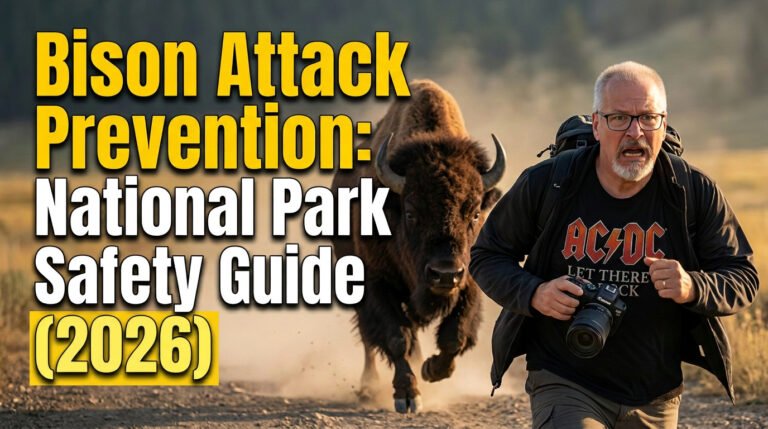
Elderly Man Tossed by Bison at Yellowstone National Park
On July 12, 2026, an elderly visitor at Yellowstone’s Bridge Bay Campground was tossed more than eight feet into the air after a bull bison charged him without warning, the second such incident in the park this year, following a June attack on a 12-year-old boy [1]. Effective bison attack prevention comes down to three habits: stay at least 25 yards away, read the warning signs, and never turn your back on the animal [2]. This guide walks through every survival rule the National Park Service teaches, plus what to do in the seconds before it is too late.
The principles of bison attack prevention are simple yet vital.
EFFECTIVE BISON ATTACK PREVENTION COMES DOWN TO THREE HABITS

Quick Answer
Ultimately, bison attack prevention is about respect for wildlife.
Bison attack prevention is 90% about distance and 10% about reaction. Keep 25 yards (23 m) from any bison, watch for pawing, tail-raising, and head-bobbing, and back away the moment a bison notices you [2]. If a bison does charge, do not try to outrun it, a 2,000-pound bull can hit 30 mph, three times human sprint speed [2]. Get behind a vehicle, tree, or boulder immediately.
Effective bison attack prevention starts with maintaining a safe distance.
Key Takeaways
- Stay 25 yards away from bison at all times in Yellowstone National Park and every other U.S. park [2].
- Between 2000 and 2015, bison injured 25 people in Yellowstone; 80% had approached the animal [3].
- Bison run 30 mph, humans top out near 10 mph [2].
- Warning signs: tail up, pawing, bluff charging, head bobbing, snorting [2].
- Do not honk at bison on roads, stay in your vehicle and wait [6].
- Bear spray works on charging bison as a last-resort deterrent, though it is not the primary tool.
- Baby bison calves are the single most dangerous photo opportunity in America, mothers charge without warning.
- Yellowstone holds the largest bison populations in the United States, with thousands roaming freely [4].
Incorporating bison attack prevention strategies can save lives.
What do bison attacks look like and how do they happen?
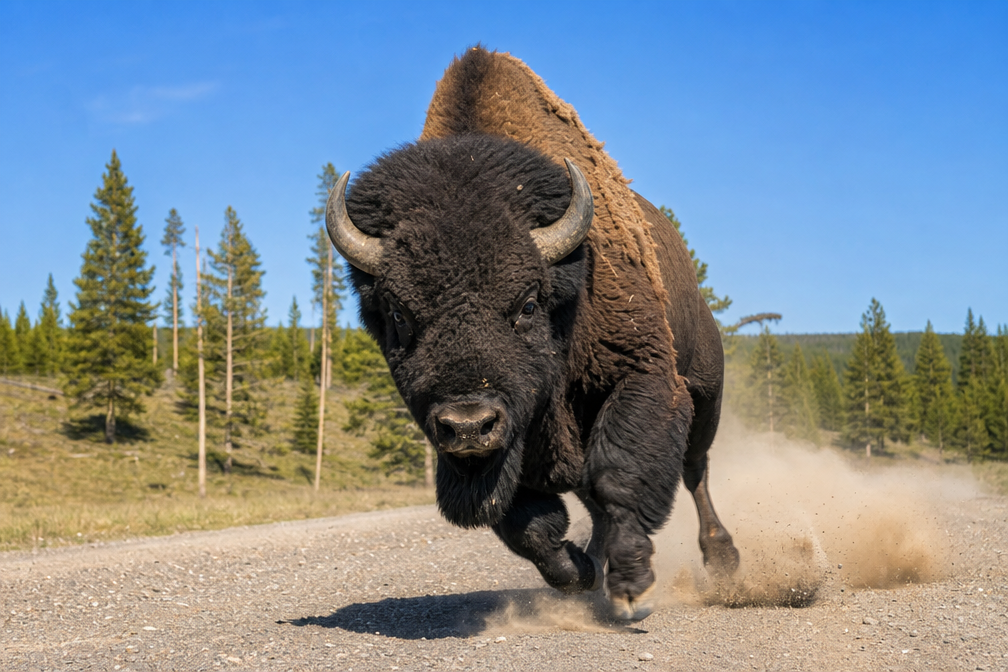
Most bison attacks unfold in under five seconds: a tourist steps within photo range, the bison lowers its head, paws the dirt, and slams the person with 2,000 pounds of muscle and horn. Roughly 80% of documented Yellowstone bison injuries between 2000 and 2015 involved visitors who deliberately approached the animal for a photo or selfie [3]. The typical pattern, according to NPS incident reports, is not a random ambush, it is a predictable escalation the person ignored.
Recent examples make the pattern painfully clear. The July 2026 Bridge Bay victim was gored and thrown after getting within a few feet of a bull [1]. In 2022, a 34-year-old Colorado man was gored near Giant Geyser after approaching a herd. Reporting from the BBC and outlets like Deseret News show the same script play out every summer in Utah, Wyoming, and Montana.
How a bison attack actually happens, step by step:
- Visitor spots bison and moves closer for a photo.
- Bison lifts head, stops chewing, orients toward the person.
- Tail goes up like a flag; pawing or head-bob begins.
- Short bluff charge (3-10 feet), often ignored by tourists.
- Full charge, contact, and toss. Total elapsed time: 2-5 seconds.
Implementing proper bison attack prevention methods can greatly reduce risks.
How close can you get to bison in Yellowstone before they charge?
| Animal | Minimum distance | Source |
|---|---|---|
| Bison | 25 yards (23 m) | NPS Yellowstone [2] |
| Elk | 25 yards | NPS |
| Bear | 100 yards (91 m) | NPS |
| Wolf | 100 yards | NPS |
| Moose | 25 yards | NPS |
Heightened awareness improves bison attack prevention outcomes.
What should I do if a bison is running toward me?
If a bison is charging, do not run in a straight line and do not freeze, put a solid object between you and the animal. A vehicle, a large tree, a boulder, or even a picnic table changes the geometry enough that most bison break off. Bear spray, deployed at 15-20 feet, is the recognized last-resort deterrent [7].
Decision rule for a live bison charge:
- Vehicle within 20 feet? Get inside, close the door.
- Tree wider than the bison’s head? Put it between you and the animal.
- Open ground only? Drop your pack (creates a decoy), zig-zag away, deploy bear spray at 15-20 feet.
- Contact unavoidable? Curl into a ball, protect head and neck, play dead until the bison leaves.
Do not climb a small sapling, bison can shove or uproot anything under about 6 inches diameter. Do not scream at the animal; bellowing back can escalate the charge.
How often do bison attacks happen at national parks?
Bison attacks are rare but consistent: Yellowstone averages 1-2 gorings per year, with occasional spike years like 2015 when five people were injured in a single summer [3]. Between 2000 and 2015, bison injured 25 visitors in the park; 22 needed medical treatment and 12 were hospitalized [3].
Compared to bee stings or drownings, the risk is small, Yellowstone hosts about 4 million visitors annually, so the per-visitor injury rate is roughly 1 in 2 million. But the severity is high: gorings routinely cause punctured lungs, broken ribs, and life-threatening blood loss. The July 2026 case at Bridge Bay [1] is a reminder that even a “quiet” campground bison is still a wild 2,000-pound animal.
What's the difference between bison and buffalo behavior?
Education on bison behavior is key to effective bison attack prevention.
In North America, “buffalo” is a nickname; the animal is technically a bison (Bison bison). True buffalo, water buffalo and Cape buffalo, live in Asia and Africa. Behaviorally, American bison are grazers that spook fast, herd tightly, and defend calves with lethal aggression, while African Cape buffalo are considered even more dangerous per encounter.
For practical bison attack prevention in the United States, the terminology doesn’t matter, the animal you meet at Yellowstone, Grand Teton, or Antelope Island State Park is Bison bison, and it will treat “buffalo” and “bison” the same way when you get too close.
Can you outrun a bison or should you climb a tree?
You cannot outrun a bison, and most trees in bison country are too thin to climb fast enough. Bison sprint at 30 mph, three times faster than a fit human, and can maintain that speed for short bursts across broken ground [2]. Climbing a mature pine 10+ feet up can work if the tree is thick and you have 15+ seconds; a sapling will snap or get uprooted.
Better options than running:
- Get behind a vehicle (best).
- Get behind a mature tree (good).
- Get behind a large boulder (good).
- Drop into a deep ditch or ravine (okay).
- Play dead as an absolute last resort after contact.
Understanding the signs of a bison can help in bison attack prevention.
What time of year are bison most aggressive?
Knowing when bison are most aggressive aids in bison attack prevention.
Bison are most aggressive during the rut in July, August, and early September, when bulls fight for mates. The July 2026 Yellowstone attack fits the pattern, peak rut, peak visitor traffic, peak risk [1]. The second high-risk window is April through June, when cows are protecting newborn calves.
Rangers at Yellowstone National Park and Elk Island National Park in Canada both note that a bison’s baseline unpredictability spikes during these windows [6]. If you visit between June and September, tighten every rule in this guide.
How do rangers prevent bison attacks in parks?
Rangers use four tools: signage, patrols, the annual bison roundup in some parks, and citations for visitors who violate distance rules. On Antelope Island State Park in Utah, the annual bison roundup each fall thins the herd, checks health, and keeps bison populations sustainable, a process covered every year by Deseret News and the Salt Lake Tribune.
Antelope Island has one of the largest bison populations in the U.S., with roughly 550-700 animals sharing the island with the bison antelope (pronghorn) herds [4]. Because the island is closed off, human conflict with bison is more concentrated per acre than at Yellowstone, rangers there run a strict distance-education program at every entry gate.
All visitors should prioritize bison attack prevention, ensuring a safer experience.
What injuries do people get from bison attacks?
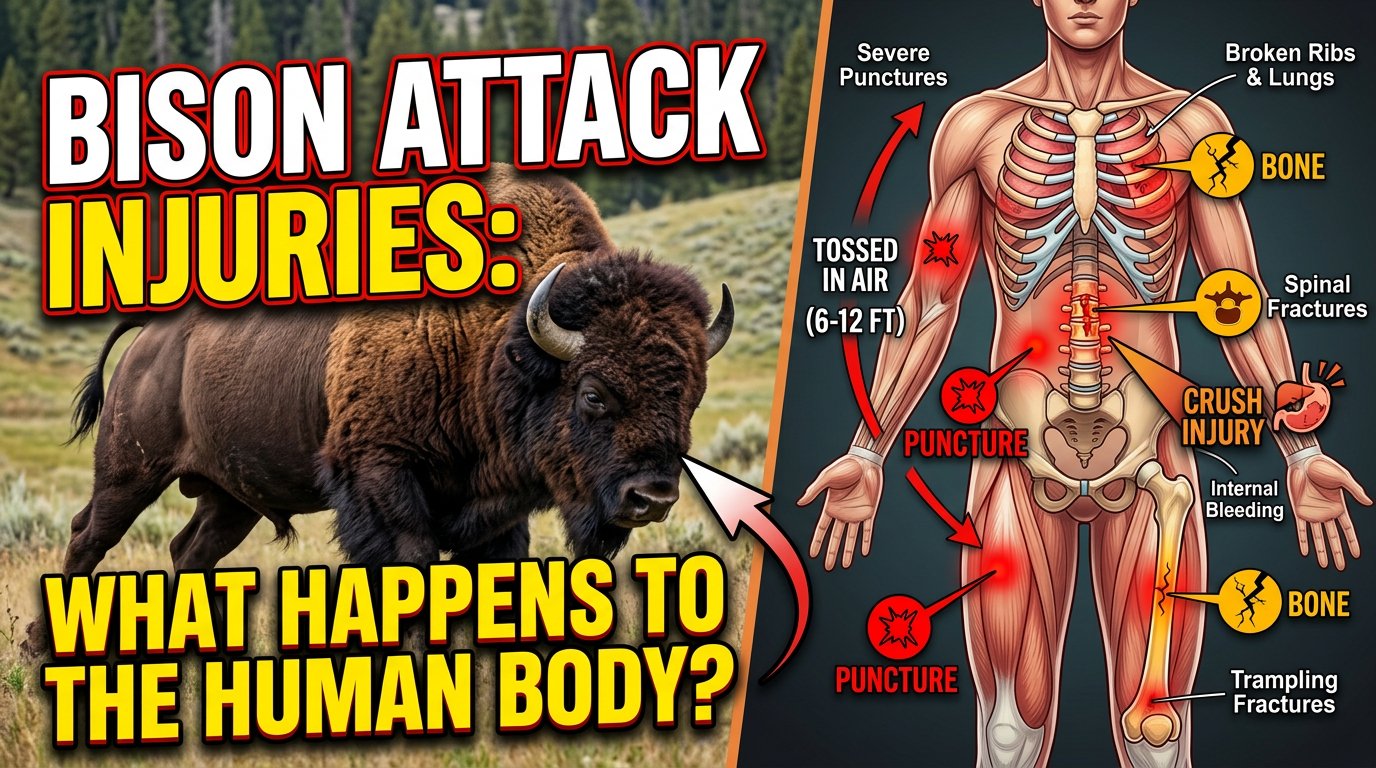
Bison gorings typically cause puncture wounds, broken ribs, punctured lungs, spinal fractures, and severe abdominal trauma. NPS injury data from 2000-2015 shows that of 25 people injured, 12 required hospitalization [3]. Deaths are rare in the modern era but do occur, the July 2026 Bridge Bay victim was in critical condition after being airlifted [1].
Common injury patterns from ranger reports:
- Horn punctures to the thigh, groin, or abdomen (most common).
- Broken ribs and internal bleeding from goring impact.
- Head and spinal injuries from being tossed 6-12 feet in the air.
- Trampling fractures if the person falls under the animal.
In summary, bison attack prevention is critical for safe park visits.
Should I carry bear spray for bison protection?
Yes, bear spray is the recommended last-resort deterrent for any charging large mammal in the United States, including bison [7]. It is not a substitute for distance, but it buys 5-10 seconds if a charge is already underway. Deploy at 15-20 feet, aim slightly below the animal’s face so the cloud rises into its eyes and nose.
Bear spray decision rule:
- Choose bear spray if you’ll hike more than 1 mile from a road in bison or bear country.
- Skip it if you’re only doing boardwalks and roadside pull-offs (distance rules do the work).
- Never store it in checked luggage on a flight, buy it after you arrive.
Are baby bison calves dangerous to approach?
Baby bison calves are the single most dangerous animal encounter in America because the mother is always within charging distance. Do not approach a calf under any circumstance, a red-orange “red dog” calf in spring means a 1,200-pound cow is watching you.
In 2016 a Yellowstone visitor famously loaded a calf into an SUV thinking it was cold; the calf had to be euthanized after the herd rejected it. Every summer, tourists at Yellowstone National Park and Theodore Roosevelt National Park try to pet or photograph calves and get charged [5]. The NPS is blunt: give calves 100 yards whenever possible, not 25.
What's the safest distance to photograph bison?
Knowing the risks involved enhances bison attack prevention strategies.
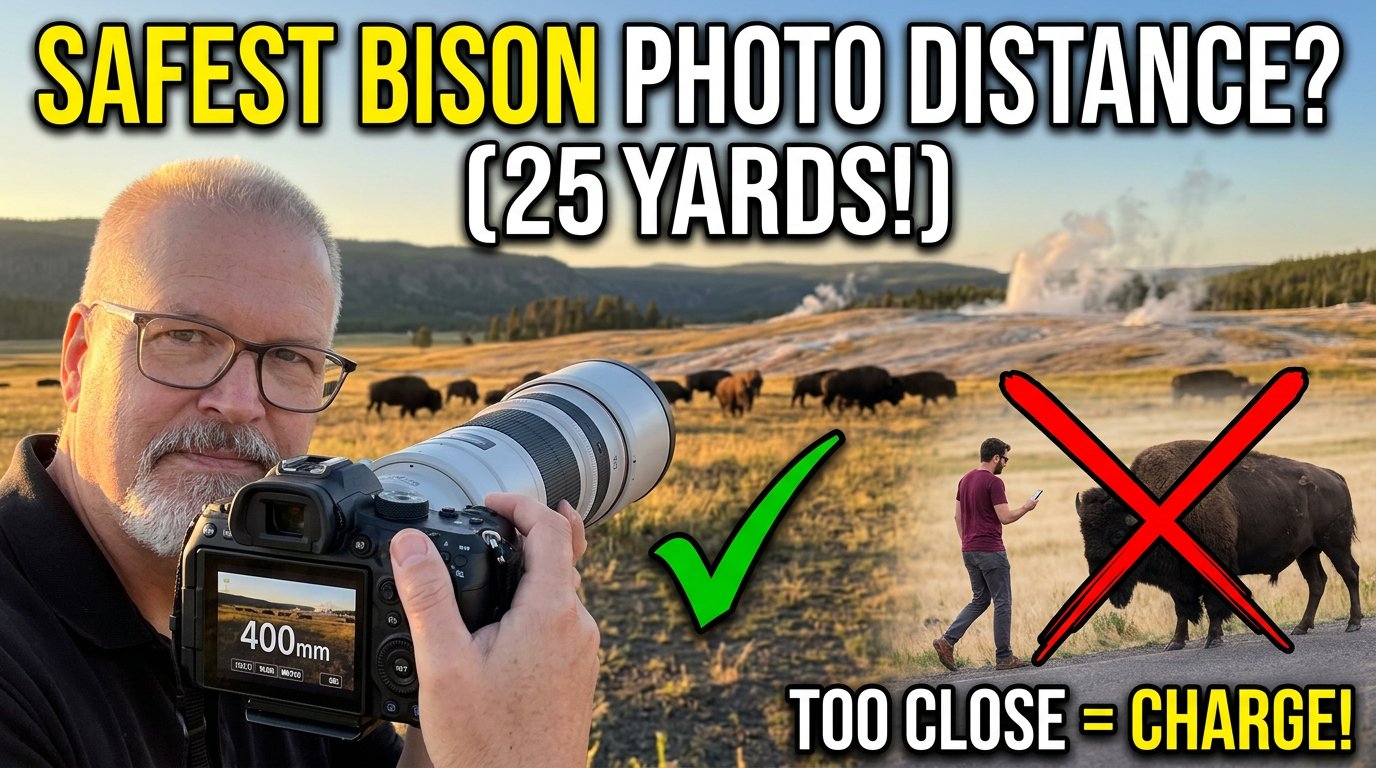
The safest photo distance is 25 yards minimum with a telephoto lens of 200mm or longer [2]. A 400mm lens or a phone with 5x optical zoom lets you fill the frame at 25 yards without any risk of triggering a charge. Most bison injuries occur when people get too close while trying to photograph the animals, a pattern documented in every ranger safety brief.
Photography rules that work:
- Use a zoom lens, not your feet, to get closer.
- Shoot from inside or behind your vehicle when possible.
- Never crouch or kneel, bison read a low profile as a threat.
- Turn off your flash; a sudden burst can trigger a charge.
- Never ask another visitor to stand near a bison for scale.
Utilizing technology can also aid in bison attack prevention.
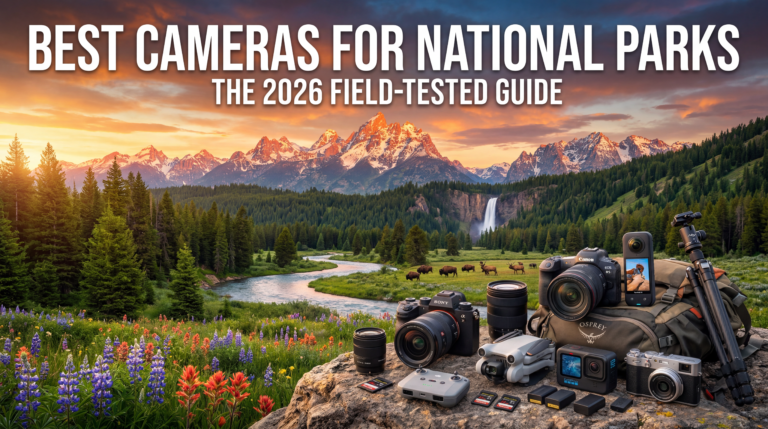
THE CAMERAS I USE TO PHOTOGRAPH BISON SAFELY
Why do bison suddenly attack without warning?
Bison rarely attack “without warning”, humans just miss the warnings. Theodore Roosevelt National Park’s safety page notes bison can attack without warning if disturbed, which is the ranger way of saying: by the time you notice, the escalation has already happened [5]. The actual sequence usually includes tail-raising, snorting, or a bluff charge that lasts under two seconds.
Common missed warnings, in order of escalation:
- Stops chewing, lifts head, stares.
- Tail rises like a flag (the #1 signal most tourists ignore).
- Head bobs up and down.
- Paws the ground, throws dirt.
- Bluff charge, a short lunge that stops.
- Full charge.
Understanding bison attack prevention is crucial for everyone visiting national parks.
What do I do if I'm hiking and encounter a bison herd?
If you meet a bison herd on the trail, stop, back up slowly, and detour at least 100 yards around them, never through them. If the herd is blocking the only route, wait it out; bison usually move within 15-45 minutes. Do not sneak between animals, especially cows and calves.
Herd encounter checklist:
- Stop as soon as you see the herd.
- Identify the closest animal and the calves.
- Back up until you have 100+ yards.
- Look for a wide detour uphill or downwind.
- If pinned, retreat to a vehicle or ranger station and report the herd.
What happens if you honk at a bison?
Strategic planning enhances bison attack prevention efforts.
Honking at a bison in the road is one of the fastest ways to trigger a charge on your vehicle. Elk Island National Park in Canada tells visitors plainly: drive slowly, do not honk, and stay in your vehicle when bison are on the road [6]. Yellowstone’s guidance is identical [2]. A honk registers as a threat; a bull may respond by ramming the door or hood.
Bison Safety Comparison: Top Parks in the United States
Best Places to See Bison in the U.S.
| Park | Bison Population | Min. Distance | Peak Risk | Risk Level |
|---|---|---|---|---|
| Yellowstone NP (WY/MT/ID) | ~5,000 | 25 yards | Jul, Sep rut | High |
| Custer State Park (SD) | ~1,300-1,400 | 25 yards | Sep roundup | High |
| Badlands NP (SD) | ~1,000-1,200 | 25 yards | May-Sep | Medium |
| Grand Teton NP (WY) | ~500 | 25 yards | Aug, Sep | Medium |
| Theodore Roosevelt NP (ND) | ~600 | 25 yards | Jul, Aug | Medium |
| Antelope Island SP (UT) | ~550-700 | 25 yards | Oct roundup | Medium |
| Wichita Mountains WR (OK) | ~650 | 25 yards | Apr-Jun calving | Medium |
| Wind Cave NP (SD) | ~450 | 25 yards | Jul, Aug | Lower |
| National Bison Range (MT) | ~350-500 | 25 yards | Jun-Sep | Lower |
| Elk Island NP (Canada) | ~600 | 100 m | Aug, Sep | Lower |
Yellowstone National Park bison encounters: recent news
Yellowstone remains the epicenter of American bison encounters, thousands of animals roam freely across the park and nearby Montana [4]. News coverage from the Deseret News, the BBC, Reuters, and the Associated Press confirms that peak-season incidents cluster tightly in July and August.
The July 2026 Bridge Bay attack pushed Yellowstone’s 2026 incident count to two, matching the average pace of recent years [1]. A June incident with a 12-year-old boy earlier this summer followed the same pattern, visitor got too close, bison charged, injuries followed. While national news cycles have been dominated by Trump administration policy debates and Iran headlines, wildlife reporters continue tracking every bison encounter across the park.
Each incident underscores the need for bison attack prevention awareness.
About bison: quick facts every visitor should know
Adopting bison attack prevention practices is essential for all outdoor enthusiasts.
Bison are the largest land mammals in North America, bulls weigh up to 2,000 pounds, cows around 1,000. They live in herds, run 30 mph, jump 6-foot fences, and swim rivers [2]. They are grazers that eat 30 pounds of grass a day and spend hours resting after feeding.
- Range: Yellowstone, Grand Teton, Theodore Roosevelt, Wind Cave, Badlands, Antelope Island, Elk Island.
- Lifespan: 15-20 years wild.
- Herd size: From a few animals to 200+ during rut.
- Vision: Poor eyesight but excellent smell and hearing.
Safety tips: the short list you can memorize
Ultimately, consistent bison attack prevention practices lead to safer experiences.
Every visitor should walk into a park carrying five rules. These are the same rules the National Park Service repeats at every entrance and on every safety pamphlet [2] [7]:
- 25 yards from bison, 100 yards from bears and wolves.
- Never turn your back on a bison. Back away facing the animal.
- Stay in your vehicle if bison are on the road [6].
- Read the tail, up means angry.
- Carry bear spray on any backcountry hike.
Life, entertainment, and finance, why bison news keeps trending
Bison stories sit at the intersection of life news, entertainment, and even finance, tourism to Yellowstone drove an estimated $832 million in regional visitor spending in a recent season, per NPS visitor use statistics. That is why every gore, every roundup, and every close call ends up as top stories on Yahoo, Deseret News, and the BBC. Sports and finance sections may push it below the fold, but wildlife safety pieces consistently outperform on time-on-page.
Related news, park stories, and recommended articles
For deeper reading on wildlife safety and current park news, see the National Park Service wildlife safety hub [7], the NPS bison visit page [4], and coverage from outlets like the BBC, Deseret News, and Reuters. For related wildlife rules, facing a bear depends on the species (grizzly vs black), you should never turn your back on a mountain lion, you can face coyotes with confidence by making yourself big, and you should proceed with caution around rattlesnakes, see the NPS wildlife pages linked above.
Remember the core principles of bison attack prevention during your adventures.
New on Yahoo and top stories about bison encounters
Yahoo News and Yahoo Life regularly aggregate top stories about people who survive bison encounters, wildlife conflict, bison antelope crossings, and the annual bison roundup on Antelope Island State Park. If you want the freshest reporting, filter Yahoo’s news vertical for “Yellowstone” or “bison attack”, it captures the wire copy from AP, Reuters, and the BBC within minutes of publication..
FAQ: Bison Attack Prevention Questions
If a bison actually makes contact, drop to the ground, curl into a ball, and protect your head and neck with your arms. Play dead until the bison walks away, usually within 30-90 seconds. Do not get up until the animal is at least 50 yards away, then move slowly toward a vehicle, building, or ranger.
Honking at a bison typically triggers aggression, not retreat. The animal may charge your vehicle, ram the door, or damage the hood. Elk Island National Park and Yellowstone both explicitly instruct drivers not to honk, stay inside, wait, and let the bison move on its own timeline, which usually takes 5-20 minutes.
A man is usually attacked by a bison after he approaches within 25 yards to take a photo, film a video, or "get closer for the kids." The bison signals with tail-up, pawing, and head-bobbing, then charges at 30 mph. Contact typically involves goring with a horn and a toss of 6-12 feet, causing punctures and broken bones.
Bison are not naturally aggressive toward humans but they are defensive, territorial, and unpredictable, especially during the July, September rut and around calves. Roughly 80% of Yellowstone bison injuries involve visitors who approached the animal. Given adequate distance (25+ yards), bison usually ignore people entirely.
Yes. Bison have poor visual acuity but excellent motion detection, smell, and hearing. Standing still does not make you invisible, they will smell you at 50+ yards. Distance, not stillness, is what keeps you safe.
Bear spray is effective as a last-resort deterrent on bison at 15-20 feet, though it is designed primarily for bears. It buys seconds during an active charge but is no substitute for the 25-yard rule.
For more information on bison attack prevention, consult park resources.
FINAL BISON SAFETY CHECKLIST BEFORE YOUR NEXT NATIONAL PARK TRIP
Effective bison attack prevention requires awareness and vigilance at all times.
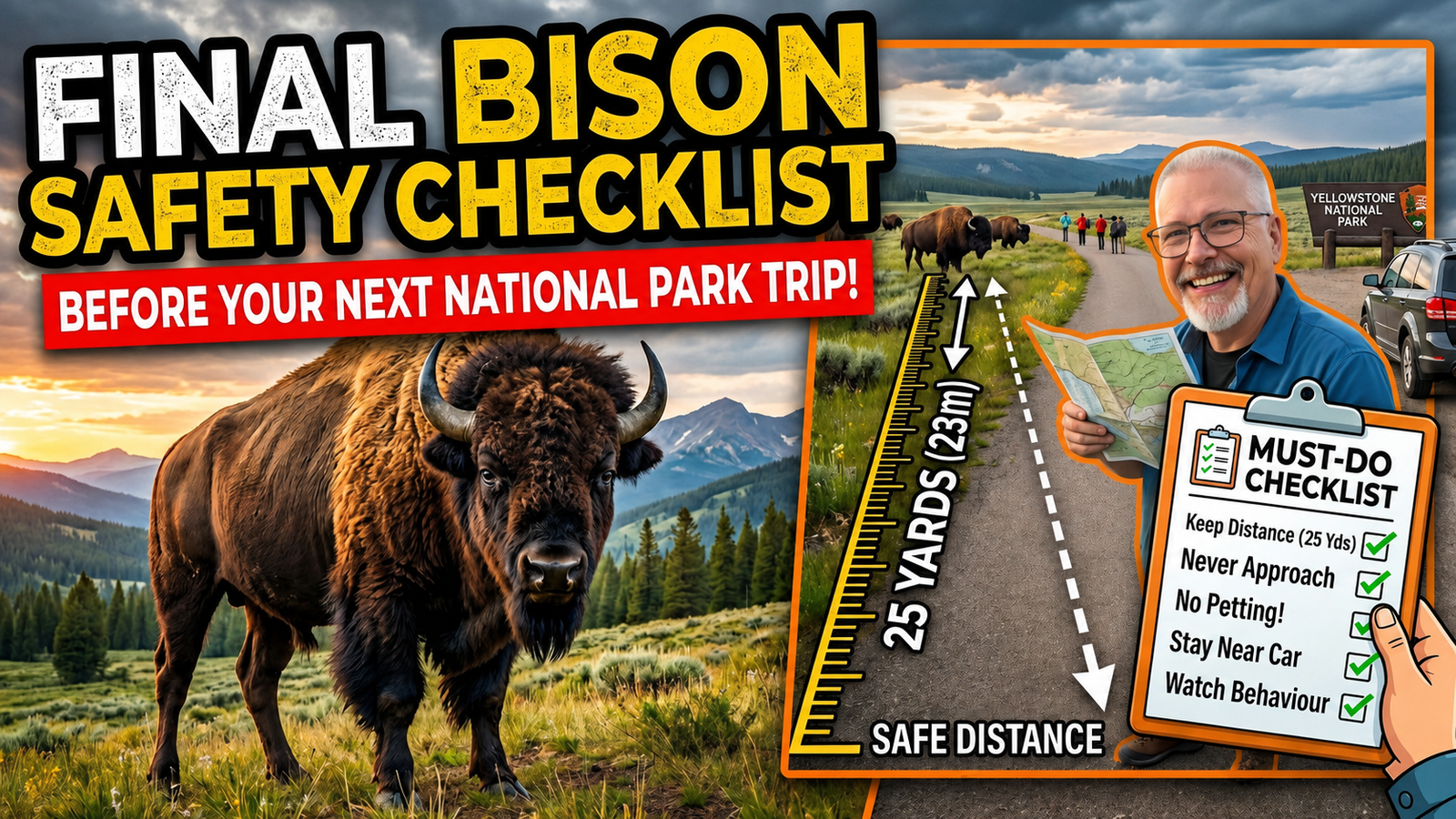
Bison attack prevention is simple—but it requires discipline. Yellowstone bison can look calm, slow, and harmless from a distance, yet they are powerful wild animals that can run far faster than a person. The safest visitors are the ones who never put themselves in a position where they need to react quickly.
Your number-one rule is the 25-yard minimum distance. That is not a suggestion for a better photo; it is the space you need to give a bison so it does not feel crowded, blocked, or threatened. If a bison starts walking toward you and closes that distance, do not stand there to finish recording. Back away immediately, change direction, or return to your vehicle.
Pay attention to warning behavior. A bison may raise its tail, paw the ground, bob its head, stare, snort, or bellow before charging. These signals mean you are too close or standing in its path. Do not try to “hold your ground.” Walk or run away, put a vehicle, large tree, or sturdy object between you and the animal, and keep moving until you have created real space.
Never approach a calf. A baby bison may look small and harmless, but its mother—or another adult in the herd—can be extremely protective. The same rule applies when bison are feeding, resting, crossing a trail, or standing near the road: give them room and let them choose where they want to go.
For photographers, use your camera gear instead of your feet. A 200mm lens is a good starting point, while a 300mm or 400mm zoom gives you even better wildlife photos without forcing you closer. Yellowstone’s own photography guidance encourages visitors to zoom with their lens, not by approaching the animal. A photo is never worth an emergency-room visit, a damaged vehicle, or putting wildlife at risk. Yellowstone photography guidance
Bear spray is also worth carrying whenever you are hiking, walking through less-developed areas, or traveling in the backcountry. Keep it accessible—not buried in a backpack—and learn how to use it before you need it. It is not a reason to get closer to wildlife; it is an emergency tool if an animal approaches or follows you while you are trying to leave.
Before you enter Yellowstone or any bison country, do these five things:
-
Screenshot the official Yellowstone wildlife safety page so everyone in your group knows the rules.
-
Buy bear spray after you land if you are flying, since it cannot go in checked or carry-on luggage.
-
Pack or rent a telephoto lens—ideally 200mm or longer—so you can photograph bison safely from a distance.
-
Brief everybody in your group, especially children, on the 25-yard rule and the fact that bison can charge quickly.
-
When bison are on the road, stay inside your vehicle, be patient, and let them move on. Do not honk, crowd them, drive aggressively, or get out for a closer picture.
Follow those habits and you will leave Yellowstone with the photos, memories, and stories you came for—not stitches, a rescue bill, or a dangerous wildlife encounter.
This guide emphasizes the importance of bison attack prevention during your visit.
In conclusion, effective bison attack prevention is essential for a safe park experience.